


This is a premium edition of The Venturist, available in full to subscribers. Subscribe for €9.99 a month or €89.99 a year to read our field guide to building a company in Europe’s hottest sector: defence technology.
Interested in group subscriptions? Contact us.
A sector like no other
“Everything is very simple in war, but the simplest thing is difficult.”
— Carl von Clausewitz, On War (1832)
The crucible of national defence has long attracted some of the most singular minds of each age, lured by the incentives of the highest order: the survival of their societies, the preservation of their liberty, and the protection of their ideals. While the broader technology sector is largely animated by market incentives, and therefore optimises for consumer convenience or engagement, the daring and eccentric innovators drawn to defence operate under a different imperative.
Commercial disruption alone cannot explain why they answer the call of statecraft. Survival raises the stakes and hostile conditions punish every error, so the systems they build must meet uncompromising, exacting standards. These demands favour people with a knack for radical invention.

But how does one actually contribute to this sector? After all, the barriers to entry are high, the endgame opaque, and the buyer bears little resemblance to a traditional enterprise customer.
Nothing about building a defence tech company is conventional. How do you market your product? Your customer won’t find you on Instagram or Google “effective defence companies near me”. You need to reach the right people while maintaining a somewhat low profile and guarding the secrecy the work demands.
Which traits do you look for in talent? Work–life balance will be even harder to preserve here than at a traditional startup, and your engineers may not be home for Christmas.
How do you sell to governments? They may be committing to a five- or ten-year contract, and they will not award it to a company they neither know nor trust. How do you even build the product capable of making any difference in a sector where governments already spend trillions?
The answers to these questions are a secret no more, as we have assembled a comprehensive guide to building in defence tech. It draws on our own research and analysis, alongside invaluable contributions from seven founders, two investors, and two executives. The companies they have built or helped run are collectively valued at over €6.5 billion, including valuations projected for the reported upcoming funding rounds.
We spoke with them about deciding to build in defence, hiring, selling to governments, building a brand, developing the product and raising capital.
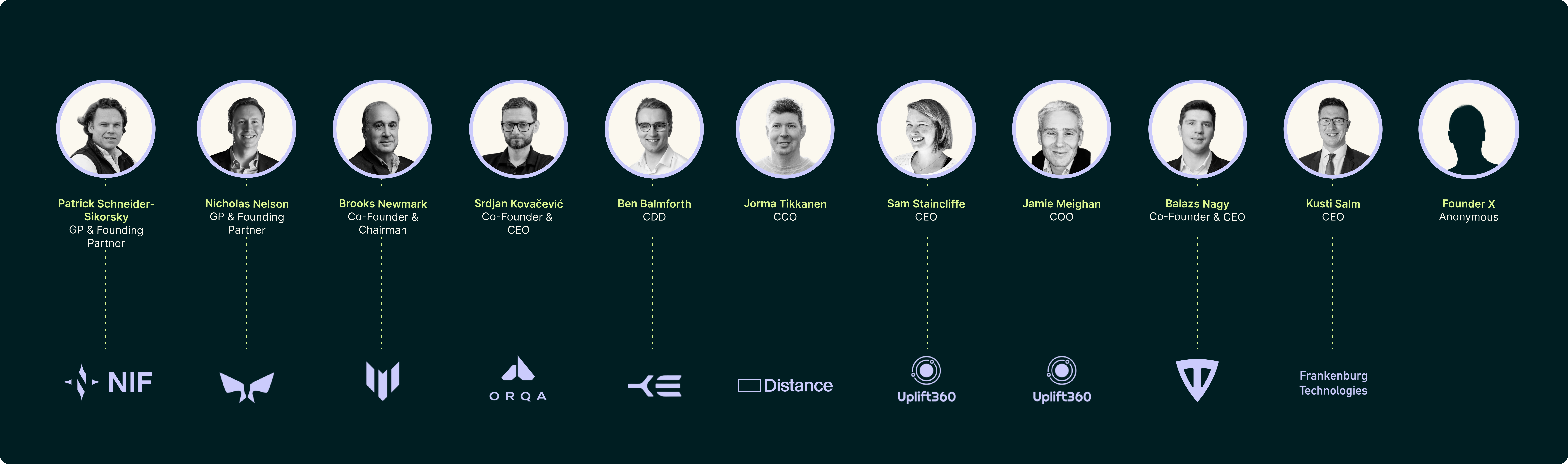
Many thanks to Patrick Schneider-Sikorsky (GP & Founding Partner at NATO Innovation Fund), Nicholas Nelson (GP & Founding Partner at Archangel Capital Partners), Brooks Newmark (Co-Founder & Chairman at Trypillian), Srdjan Kovacevic (Co-Founder & CEO at Orqa FPV), Ben Balmforth (CDD at TEKEVER), Jorma Tikkanen (CCO at Distance Technologies), Sam Staincliffe & Jamie Meighan (CEO and COO at Uplift360), Balazs Nagy (Co-Founder & CEO at TYTAN Technologies), Kusti Salm (CEO at Frankenburg Technologies), and Founder X (remained anonymous).
What you can expect in this guide
“Expect the unexpected, and make certain you deliver.”
— Srdjan Kovacevic, Orqa FPV, when asked what founders must understand before entering the sector
No guide can prepare you for every surprise, but this one can help you make the decisions you know are coming. It explains how to:
identify a military problem and choose the right company model
assemble a team
design for integration, evolving threats and production at scale
deepen your moat
understand procurement and primes
build credibility
finance the journey from prototype to production
create a company that remains strategically valuable
We’ll take these steps in order, from choosing your direction all the way to the endgame:
Part I: Decide what to build
Step 1: Start with a mission and a problem
Step 2: Identify the customer and choose the first company model
Part II: Build the team, product and supply chain
Step 3: Build the founding team and talent base
Step 4: Develop with users and design for deployment
Step 5: Build production and a moat
Part III: Win customers and finance growth
Step 6: Communicate with proof and win contracts
Step 7: Finance scale and keep the endgame open
Part I: Decide what to build
Unlike many of the great players before him, Garry Kasparov treated openings not as passive warmups but as means to seize the initiative and ruthlessly dismantle his opponents before the positions could settle. “The opening is the only phase that holds out the potential for true creativity and doing something entirely new,” he once wrote.
For your company too, every later move will inherit the position created at the start. There is no single right opening move, but your first choices will determine an awful lot about the endgame. Ask yourself: “What am I trying to achieve here? What kind of a company should do this?”
“If you are starting a defence company today, you need to understand that you are not entering a normal B2B market; you are entering a sovereign, geopolitical arena. Technology is only 20% of the battle; the remaining 80% is regulatory navigation, compliance, security, and capital endurance.”
— Ben Balmforth, TEKEVER
Your company begins as a quest with a clear objective. As Anduril’s founder Palmer Luckey put it: “I didn't start Anduril because I thought it was a great business opportunity. I started Anduril because I thought it was a national security crisis... If we don't solve this problem of getting the best technology into the hands of the West and our allies, nothing else we build in Silicon Valley is going to matter anyway.”
Find the right reasons for yourself:
“You need to be doing it for the right reason. Defence is hard. Hardware is hard.
The most successful founders we've seen are the ones who are the most mission-driven and mission-aligned, who have a good understanding of why they're building this and a good appreciation of the geopolitics and are not doing it or getting into it because they think ‘oh there's a lot of defence money here, and I'm just going to go after that opportunistically’.”
— Patrick Schneider-Sikorsky, NATO Innovation Fund
And beware of the wrong ones:
“But if you’re looking for fame, fortune, you know, if you wanna be the next Andreessen success story, good for you, but you’re in it for the wrong reasons.
If you wanna work with some of the best customers in the world and solve some of the hardest and most important problems out there, then you’re in the right place. But there are much, much easier ways to build a huge company.”
— Founder X
“If you are in it for the money, you are in it for the wrong reason. You want to work with people you enjoy working with, and you have to believe in the mission behind the product.
In any startup, you need to genuinely like the mission and the people you work with. There is no point in being miserable. […]
I worked at Apollo, one of the best private-equity firms in the world, but I was not as happy as I am now building my own startup.”
— Brooks Newmark, Trypillian
You need a serious reason to enter defence. Your days will not be spent building features to increase screen time or click-through rates. You will be confronting problems of immense national importance, and only a quest of sufficient magnitude can carry the weight of that duty.
Here’s how to start.
Step 1: Start with a mission and a problem
Spend a little time around venture capitalists and someone will eventually sermonise about “starting with the problem”. Though the phrase has been mercilessly recycled over time, it holds water. Without a problem, you’re just a hammer roaming around the workshop hunting for nails.
“Do not build a solution looking for a problem. Start with a deep, visceral understanding of operational gaps on the ground.”
— Ben Balmforth, TEKEVER
Defence customers, in the end, buy an outcome. Technology follows from the problem and from the conditions in which it arises; it never leads.
“I would tell [founders] to start with a problem statement rather than a specific technology. Defence technology increasingly is about generating a mission effect rather than how you do it, yet too often founders focus on the technology instead of the effect.”
— Nicholas Nelson, Archangel Capital Partners
Find a problem worth solving
Fine, start with the problem. But which one? There are so many! The world, especially in wartime, offers no shortage of them. To distinguish a problem worthy of your quest from one that is merely interesting, test it against some questions:
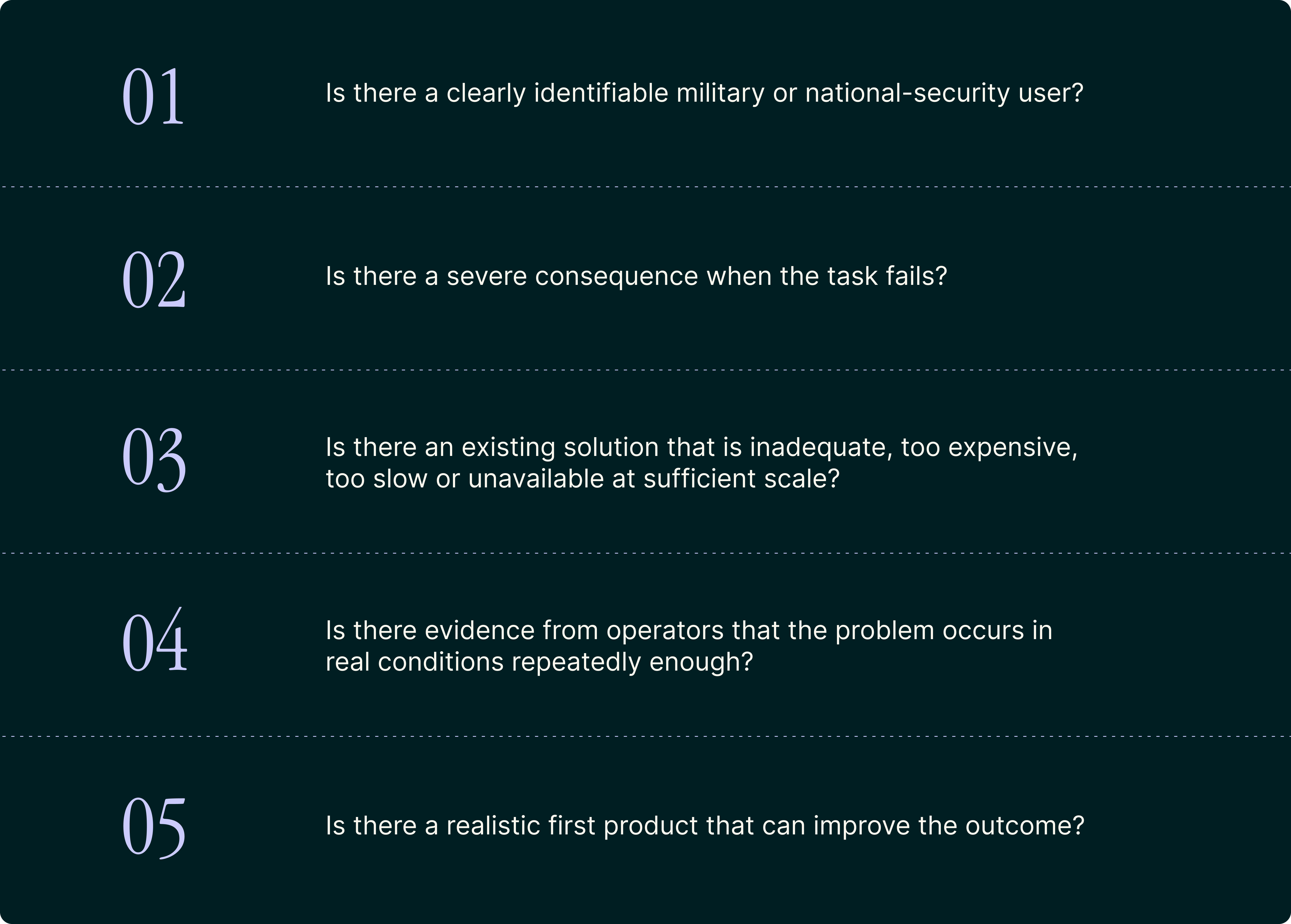
A problem worthy of your quest should draw affirmative answers to these questions. Do not settle for a mere appetite for novelty. A user’s interest and excitement are welcome signs, but neither is sufficient reason to take up the quest just yet. Establish a genuine need, and be conservative about what you accept as evidence of it.
Consider Uplift360’s example:
“The war in Ukraine, COVID and ongoing geopolitical tensions have exposed just how dependent Western economies are on a relatively small number of countries for critical materials and manufacturing capacity.
Europe generates significant volumes of advanced composite waste whilst simultaneously importing many of the materials needed by aerospace, defence and industrial manufacturers. Recovering and regenerating those materials creates more than a sustainability benefit—it creates domestic capability and reduces strategic dependence on fragile global supply chains.”
— Jamie Meighan, Uplift360
Define the military effect
“We start from the mission, not the technology. Our company originated out of a Kyiv hackathon by solving a simple question – within a complex problem: How can we stop Russian Shahed drones at scale? The answer was interceptor drones.
We’re not building drones for the sake of building defence technology - we’re building solutions to protect people and critical infrastructure from a specific, growing threat: cheap, mass-produced drones that legacy air defence can’t affordably counter.”
— Balazs Nagy, TYTAN Technologies
Stripped to its essentials, a military effect is the outcome you want to produce on the battlefield. Before imagining its technological vessel, force yourself to describe that outcome plainly. What must the user be able to do? Against what? Under which conditions? And why is the existing solution ineffective?
